

Bulk RNA-Seq uses short read sequencing to deliver a comprehensive snapshot of gene expression across the entire transcriptome, making it a powerful and versatile tool in drug development. This technology is widely used to facilitate the identification, validation, and optimization of new therapeutic strategies by providing detailed insights into gene expression profiles under various conditions. This capability enables us to identify potential drug targets, decipher mechanisms of action, and evaluate the effects of drug candidates, among other applications.
Differential expression analysis involves comparing the transcriptomes of samples under various experimental conditions—such as drug treatments, tissue comparisons, or dose escalation studies—to identify genes that show statistically significant changes in expression levels. This process uncovers key genes and pathways that are differentially regulated, providing valuable insights into the underlying biological processes. Such insights can advance our understanding of disease mechanisms and the development of effective treatments.
But what if no differentially expressed genes are found? Does this mean that the treatment is ineffective or the experiment didn’t work? One client recently faced this challenge and approached us to gain a better understanding of the situation. They had conducted bulk RNA-Seq on a limited number of patient samples to observe a drug’s effect on the transcriptome but did not find any differentially expressed genes.
We had encountered this situation before.
A previous client had conducted a dose-response study with a new compound that exhibited significant effects both in vitro and in vivo. Using bulk RNA-Seq, we monitored the genomic responses to various doses of the compound administered to cell cultures.


At the highest, physiologic dose, the effect was undeniable: thousands of genes exhibited significant changes in expression as vividly illustrated in a volcano plot (figure 1). In this high-dose scenario, the plot resembled an explosive burst, with many genes showing significant upregulation or downregulation, far exceeding the standard significance threshold. As the dosage decreased, fewer genes met the criteria for significant differential expression, and no genes surpassed the significance threshold at the lowest dose. While this pattern might suggest that the drug did not impact gene expression at the lowest dose, our expertise prompted us to dig deeper.

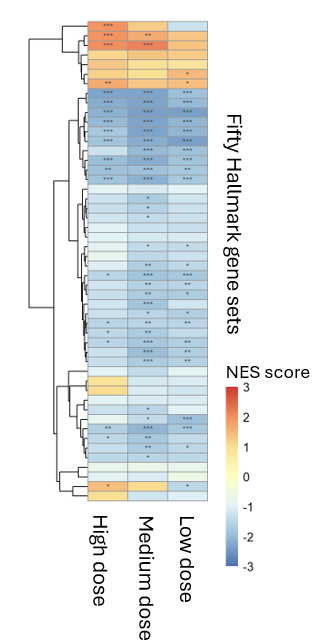
A negative NES Score means the gene set is downregulated on compound treatment relative to control.
Asterisks indicate statistical significance.
Employing GSEA for Deeper Insights
We applied the pathway analysis tool, Gene Set Enrichment Analysis (GSEA), to more closely examine the dataset. GSEA examines groups of genes within pathways, enhancing our statistical power and reducing the need for extensive multiple testing corrections. It aggregates subtle changes across many genes, enabling us to detect significant pathway activities across all doses tested, including the lowest dose (Figure 2). This finding revealed that the treatment could impact the transcriptome even when changes at the individual gene level were not detectable.
We learned this trick because we also happened to be running GSEA on every differential expression analysis conducted at Diamond Age. When we saw these data line up in Figures 1 and 2, we realized that GSEA could “rescue” experiments that yielded inconclusive gene-level results.
This was the approach we took with our current client. By applying GSEA to their datasets, we identified significant effects within specific biological pathways. This highlighted areas for further investigation and underscored the need to expand sample sizes in future studies.
Your Partner in Discovery
At Diamond Age, we view each dataset as a potential treasure trove of insights. We go beyond taking data at face value, rigorously analyzing each dataset with a comprehensive—and sometimes bespoke—suite of tools to uncover hidden biological activities. Moreover, our commitment to methodological rigor is matched by our dedication to collaborative research. We work closely with our clients’ scientific teams, not merely as service providers but as true research partners. This collaborative approach ensures that our analyses precisely address the specific scientific questions at hand and adapt to the unique requirements of each project.
For researchers grappling with inconclusive data or suboptimal analysis methods, consider partnering with Diamond Age. We give every dataset a second chance to reveal its secrets.